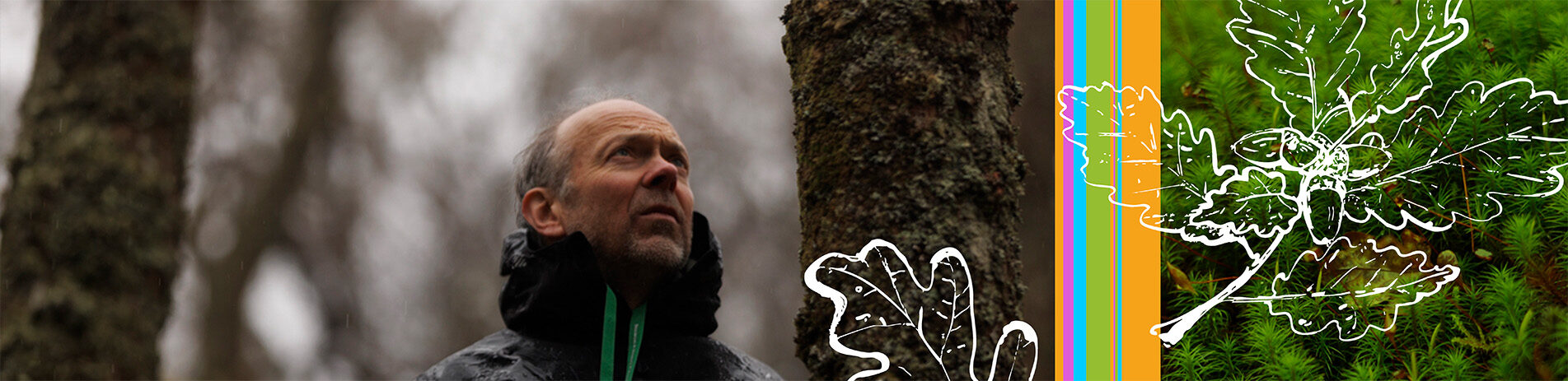
National Park Nature Hero Dr. Oliver Moore – bonkers for bryophytes!
When our Nature and Land Use colleagues nominated Dr. Oliver Moore to be a National Park Nature Hero, we knew we had to pay attention!
Our staff are privileged to meet and work with many accomplished people who are passionate about nature restoration, and Oliver is certainly that. His bryophyte and lichen expertise is helping us identify areas of rainforest to protect and enhance, but as important is his enthusiasm and ability to explain bryophytes to a wider audience, so that we can all appreciate the vital role they play in supporting our environment. In this guest blog, Oliver shares with us his fascination for oldest land plants on earth.
“The first words I ever remember uttering from my cot were “What’s that?” and I still often find myself asking that same question to this day. Being able to recognise a fellow life-form is the first step to understanding more about its ecology. I see humans as part of nature and I’ve come to realise that what we do to other-than-human nature, we do to ourselves. For example, I was horrified to learn that there have been several extinction events within our own gut microbiome over the last few decades. I’m talking about the friendly micro-organisms living within our digestive system and I wonder what the consequences may have been from losing some of these species on a permanent basis. When I am scrutinising species through a hand-lens, whether it be a slime mould or a resting micro-moth or some other wonderful being, I reflect on how they have as much right to be on planet Earth as what I have and should be treated with reverence.
My path towards a career dedicated to protecting nature began in my teens. I was working as a chemical analyst for a big manufacturer of pharmaceutical and weedkiller products at the time and had begun to question whether I could be doing something more beneficial towards the planet. A colleague knew I was into natural history and suggested I study Environmental Science at university. Nobody in my family had ever been to university and so it had never been on my radar previously.
I first became fascinated by bryophytes (mosses, liverworts and hornworts) in my twenties whilst on a university fieldtrip looking at woodland. I was contemplating the mosses on a tree when my lecturer strode past and called out a scientific name. It was only then I realised that moss had names! That there were different species of moss and that they could be identified was enthralling. I got into lichens along the way because they were often encountered growing with bryophytes.
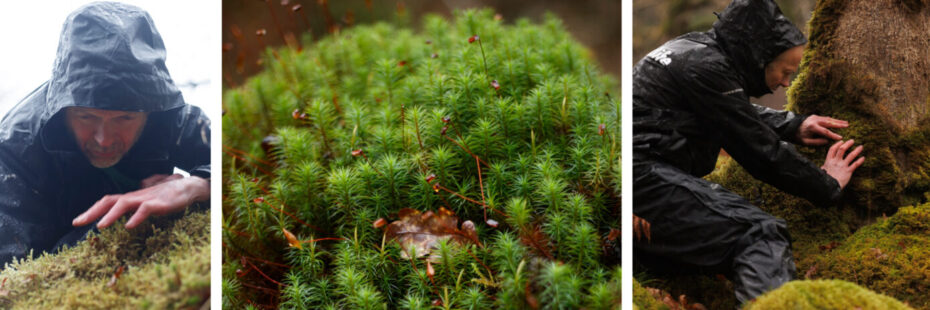
Dr. Oliver Moore studying bryophytes
Later in life, I was fortunate enough to embark on a TCV Natural Talent Apprenticeship in bryology and hosted by the Royal Botanic Garden Edinburgh. The scheme aimed to ensure there was a future generation of expertise in Scotland for different taxonomic groups. This led on to PhD research looking at the impact of Red Deer management on bryophyte and lichen ecology in the northwest Highlands. Eventually I found myself working for Plantlife Scotland as Bryophyte and Lichen Specialist which demonstrates how important that Natural Talent Apprenticeship proved to be. It is also deeply satisfying to be repaying all those who have invested time, effort and funds to have made this possible.
I am grateful to Plantlife Scotland for having the foresight to create my current role as it has enabled me to engage with community and practitioner groups throughout Scotland’s rainforest zone. Plantlife is one of the lead partners within the Alliance for Scotland’s Rainforest (ASR). This is a voluntary partnership of 20+ organisations devoted to protecting, restoring and expanding our globally rare temperate rainforest. My Plantlife remit, within the ASR, is to make sure that internationally important bryophytes and lichens are at the heart of temperate rainforest management since these are the organisms that define this globally rare habitat.
I would urge readers to value the fantastic bryophytes and lichens and other wildlife associated with trees. Studying bryophytes and lichens (and other fungi) is challenging but very rewarding and can tell us so much about specific woodlands. In the last year or so, I have been working with Loch Lomond & The Trossachs National Park volunteers to help them recognise some indicator species in the hope that they will go out and start making valuable records that can be used by the National Park. The workshops have been well-attended, and I am encouraged that there is plenty of interest in this field. Being around fellow naturalists gives me great heart, and I hope the National Park can maintain this level of interest.
When you are looking at bryophytes and lichens it takes ages to explore new territory, and I have barely scratched the surface in the National Park. Consequently, it should come as no surprise that one of my favourite places is a lovely old willow tree, in the Loch Iubhair car park, that supports a fabulous colony of a nationally scarce jelly-lichen known as Gabura fascicularis (aka. Octopus-suckers). I just hope lovely old trees like this can be protected from various pressures and that young trees continue to be able to become veterans in places close to water – where the humidity is valuable for rare lichens and bryophytes that grow on trees. Another wish for the National Park and more widely for Scotland, is that we will one day see the re-instatement of our top predators. I appreciate that they may not do what we would expect but I think it is still worth trying to restore proper ecological functioning.
In general, I think nature will be fine; to know that there is a fungus living in the old nuclear reactor at Chernobyll is amazing. Whether humans will still be around to marvel at fellow organisms in the years to come is another question.”
If you know someone who’s passion for nature inspires, educates and encourages action in others, nominate them now.